
For most solo motorcycle campers, the Naturehike Cloud Up Base 1-person, Bright Orange is the best starting point in this group. It gives the rider a short stated bundle with a footprint and dedicated poles, so the shelter plan does not depend on the campground. The trade is a genuinely small living arrangement: one person, one door, and one vestibule. Clostnature becomes the better fit when two people share a fly or one rider needs more protected gear space. Backwoods Bungalow belongs on a different route entirely, one where trees or walking poles are already guaranteed.
Our recommendations
Choose by the problem your trip creates
Fast answers before the details.
Naturehike Cloud Up Base 1-person, Bright Orange
Short listed bundle with a footprint and dedicated poles
Best default when the luggage opening controls View details →Clostnature 2-person, Green
Two doors and two vestibules for access and gear separation
Best when camp routine needs more room View details →OneTigris Backwoods Bungalow 2.0, Coyote Brown
Shelter that uses trees, sticks, or walking poles as structure
Best when supports already travel with you View details →Naturehike Cloud Up Base 1-person, Bright Orange: the easiest solo system
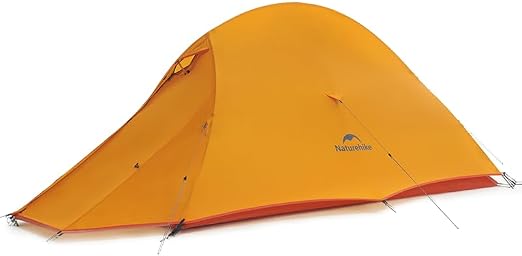
Start with the luggage opening. The Cloud Up's listed packed size is 15.3 x 5.1 x 5.1 inches, which gives a solo rider a clear number to compare with a pannier or top case. It is not a confirmed fit: the outside bag measurement says nothing about the longest rigid pole section inside it, and fabric can compress where aluminum cannot.
That distinction is the reason this tent leads the lineup. The listed kit includes a footprint, carry bag, tent poles, wind ropes, and stakes. A rider can plan around one supplied shelter system instead of deciding later whether the site will provide trees or whether a separate support belongs on the bike. The compact bundle solves a motorcycle-specific planning problem even before the tent is pitched.
The interior sets the boundary. This is a one-person, double-layer shelter with a mesh inner, front door, and one vestibule. The vestibule can take boots and a jacket while the sleeping area stays clear, but it is not a spare room for a helmet, riding suit, and every wet layer from the road. The Cloud Up is easiest to live with when the rider decides in advance what must stay under cover.
That is a useful compromise rather than a hidden flaw. The Cloud Up is the cleanest answer when one rider values a short, supplied-pole system and can keep the vestibule's job narrow. When the camp routine requires more than one protected gear zone, the larger Clostnature bundle has a reason to exist.
Clostnature 2-person, Green: space that earns its place

At a two-person campsite, the doorway is part of the floor plan. Clostnature's Green two-person design has two doors and two vestibules, so two riders do not have to cross the other sleeping position to get out. For one rider, those same openings can divide the arrival: one side for entering and sleeping, the other for boots, helmet, or wet riding layers.
The nominal floor is 86.6 x 59 inches, enough information to plan around two pads but not enough to promise a dry motorcycle-gear locker. The distinction matters because a two-person label describes sleeping positions. It does not tell you how much space remains after a helmet, boots, jacket, pants, gloves, and luggage enter the shelter system.
The carry is larger than Cloud Up's. The listed packed size is 16.5 x 5.9 x 5.9 inches, and the kit describes an inner tent, flysheet, two aluminum poles, four ropes, fourteen stakes, a carry bag, and a pole repair kit. Those pieces make the shelter more self-contained than a poleless design. The extra length earns its space when independent access and a place for wet gear are daily camp requirements.
Think of the two vestibules as separate camp jobs:
- one keeps an exit usable while the other holds gear;
- two riders can approach their own side without climbing over a pad;
- a solo rider gets more options for separating dry sleeping kit from damp riding layers.
Clostnature is still not a guarantee of roomy living once two pads take the floor. Its role is practical access and gear separation, not a promise that all motorcycle luggage belongs indoors. That makes it a meaningful step up from Cloud Up for two-up travel or wet solo routes, while the smaller tent remains the better-shaped answer for a tight solo load.
OneTigris Backwoods Bungalow 2.0, Coyote Brown: the site supplies the structure

Backwoods Bungalow makes its defining choice before the rider reaches camp: dedicated tent poles are not part of the listed package. The shelter uses two trees or separate sticks or walking poles for support, along with the supplied guylines and pegs. The missing pole bundle is an advantage only when the route already supplies what replaces it.
The manufacturer/listing package describes the shelter, ten pegs, six guylines, and a stuff sack. Its folded shelter size is about 16 x 8 inches, but that is a two-dimensional measure of the shelter bundle, not the size of a complete ready-to-pitch system. Add the support plan to the luggage calculation before comparing this bag with a framed tent.
The canopy and open front create a porch-like edge, while the mesh entrance, rear vent, and tie-outs describe a more configurable shelter than the enclosed dome options. That can give wet boots or a jacket a place outside the sleeping area. It also makes the campsite decisive: a wooded site or carried walking poles can make the design sensible, while an unknown destination or a bare pad can remove its main advantage.
Test the whole shelter against the luggage
The useful pre-purchase measurement is the narrowest opening the shelter must pass through. Measure that opening at its actual lip, then compare the result with the bag rather than the pannier's largest outside dimension. Cloud Up's 15.3-inch length, Clostnature's 16.5-inch length, and Backwoods' about 16-inch folded length look comparable until their definitions are put beside each other.
Next, identify the rigid pieces. A soft fabric bag can give a little; a pole section cannot. For Cloud Up and Clostnature, find the longest pole section and decide where it will travel. For Backwoods, the support question moves outside the bag: walking poles or suitable sticks must either already travel with the rider or be reliably available at camp.
Finish the test with the complete kit laid out together: bag, footprint if supplied, poles or supports, ropes or guylines, and stakes or pegs. This is not a promise that a listed dimension fits a particular motorcycle. It is a way to catch the more common mistake of measuring the compressible shelter while ignoring the part that controls the opening. The broader motorcycle loading guide covers the rest of the bike's load plan.
Count protected storage, not just sleeping pads
The sleeping capacity is only the first layer of a motorcycle tent decision. After a wet ride, the shelter also has to handle the helmet, boots, gloves, jacket, pants, and whatever luggage should not become part of the bed.
Cloud Up gives one vestibule for that boundary. Clostnature gives two, which changes both access and where damp gear can wait. Backwoods can form a porch-like covered edge with its open front, but that area depends on the support and staking plan and should not be counted as an enclosed vestibule.
The practical question is what must stay under the fly. If the answer includes the helmet and wet riding layers, the extra vestibule or canopy may justify a larger or more conditional shelter. If those items can stay elsewhere, a one-person tent can keep the motorcycle load smaller without pretending that its sleeping area is storage.
Match the tent to the route's support system
Cloud Up and Clostnature list dedicated poles. They still need their listed stakes and ropes to be useful, but their structural plan travels in the bag. Backwoods lists shelter hardware and expects the site or the rider to supply the uprights. That difference is most important when the destination is not known in advance.
An established campground can offer a flat pad and no trees. A wooded site can provide the opposite of that problem. A mixed route may include both, which makes a supplied-pole shelter the lower-dependency choice unless walking poles are already part of the riding plan. Where Backwoods does fit, its compact shelter bag is an intentional exchange for more site planning.
Stakes and pegs remain part of every comparison. An included set helps only when the ground accepts it, and a tent that depends on extra supports still needs those anchors. Treat the shelter, supports, guylines, and anchoring pieces as one travel system before deciding which bag is compact.
A wet arrival exposes the hidden dependencies
The relevant question after a long day is not a claimed setup time. It is what must be found before the fabric becomes a shelter. Cloud Up names a footprint, poles, wind ropes, and stakes alongside the bag. Clostnature names its inner, flysheet, two poles, ropes, stakes, bag, and repair kit. Backwoods names the shelter, guylines, pegs, and bag, then adds the trees, sticks, or walking poles that make the structure possible.
That is why the smallest-looking bag is not automatically the easiest camp. A supplied-pole tent asks the rider to stage its own pieces. A support-dependent shelter asks the rider to solve a site problem first. Neither description is a field test or a timing claim; it is a comparison of documented dependencies and the consequences those dependencies create when the camp is wet, dark, or unfamiliar.
Reference desk
Sources
- Clostnature three-season setup sheet
Clostnature