
A portable inflator is a pressure-management tool, not a complete tire-repair system. The useful one is the model that reaches the valve on your loaded motorcycle, returns the tire to its specified cold pressure, and still has enough battery or duty-cycle margin for the job. Maximum PSI is only a ceiling.
For most solo motorcycle-camping loads, the Fanttik X10 Pro is the best place to start. Its 0.96-pound manufacturer weight and defined 25-inch-tire benchmark keep the tool compact without making motorcycle use an assumption. The ETENWOLF S1 is the reserve-first alternative, the NOCO Air AL5 is the better choice when very low pressure and manual start matter, the Fanttik X9 APEX is the larger capacity and power-bank platform, and the ETENWOLF S0 is the minimum-bulk option for riders willing to accept a bike-first boundary.
Our recommendations
Choose by the pressure job
Fast answers before the details.
Fanttik X10 Pro
A motorcycle-first compact tool with a defined fill benchmark
Best for ordinary pressure correction View details →ETENWOLF S1
More battery and a broad kit for repeated corrections
Best when reserve earns the carry weight View details →NOCO Air AL5
Documented manual start below 3 psi
Best for a nearly empty tire View details →Fanttik X9 APEX
Higher capacity with light and power-bank output
Best for remote or multi-tire work View details →ETENWOLF S0
A bike-first tool for riders counting every ounce
Best when the boundary is acceptable View details →Choose the pressure job before the pump
| Your priority | Best fit | What you give up |
|---|---|---|
| Compact, motorcycle-first carry | Fanttik X10 Pro | Less reserve and no documented power-bank output |
| More battery reserve and a broad kit | ETENWOLF S1 | More weight, heat, and hose-access compromises |
| A very low or fully flat tire | NOCO Air AL5 | Manual start below 3 psi and a planned cooldown |
| Repeated corrections and shared power | Fanttik X9 APEX | A 1.87-pound carry burden |
| The smallest workable pump | ETENWOLF S0 | Bicycle-first evidence rather than a comparable motorcycle fill test |
The motorcycle maintenance guide is the companion to this comparison. It separates inflation from plugs, tube work, wheel support, and recovery. If the tire has a structural problem or will not hold pressure, another pump cycle is not the repair plan.
The setup that makes an inflator useful
Start with the motorcycle's cold specification. Michelin's motorcycle tire-pressure guidance directs riders to the owner's manual or vehicle information plate rather than the maximum printed on the tire sidewall. It also says not to bleed a hot tire. A pump rated to 150 or 160 psi does not tell you whether it is the right pump; it tells you only how far its ceiling extends beyond the motorcycle's normal target.
Keep a separate gauge in the same pouch. The Motorcycle Safety Foundation's T-CLOCS checklist calls for checking cold pressure with an accurate gauge. A pump display can guide the fill, while the gauge gives you an independent final reading when a valve connection, display, or hose position is behaving strangely.
Do the connection test with the luggage fitted. Reach both valves, route the hose around the pannier or tail bag, and make sure the chuck can be released without pulling the valve. Connect the pump to the exact battery or outlet you will carry. The camping shakedown test is the right place to practice this sequence because a pump that works on a bare bike can fail once the travel load is installed.
Battery reserve is also a packing decision. Charge the pump before departure, carry the correct lead, and leave room around a unit that needs to cool. An automatic stop shortens the attention required during a fill, but it does not turn a pump into a gauge or remove the need to watch the valve and tire.
Fanttik X10 Pro: the compact default

The X10 Pro answers the most common luggage problem first: a solo rider wants a real motorcycle tool without giving an entire bag to the compressor. Fanttik's comparison page lists the unit at 0.96 pounds and groups it with sedan, motorcycle, bike, and ball use. That combination makes the product a useful default for ordinary pressure correction rather than a generic high-pressure gadget.
Its most useful number is not the 150 psi ceiling. Fanttik reports 60 seconds to move a 25-inch tire from 30 to 35 psi and gives a separate 3.5-tire result from 0 to 35 psi. The tire size and pressure change define those results. They are manufacturer benchmarks, not a promise that every motorcycle tire will fill at the same speed, but they are specific enough to anchor a compact comparison.
The X10 Pro also keeps the operating sequence tidy. The hose and accessories store against the body, and the automatic stop can end a fill at the selected target. Those features matter when the pump comes out beside a gauge and a repair kit. They cannot compensate for a connector that is hard to reach, so the loaded-bike test remains part of the recommendation.
Customer accounts describe easy motorcycle carry, quick top-offs, and modest battery use. Other accounts mention noise and a slower result on a different tire; one detailed report says the separate 35-second claim did not hold on a 16-inch tire and that a larger pressure increase took about four minutes. That is a useful limit on the marketing number, not a reason to discard the defined 25-inch benchmark.
The X10 Pro is the one to buy when size and access are the main constraints. Pick the S1 when repeated corrections justify more reserve, or the X9 APEX when a larger battery and power output have their own job. The X10 Pro keeps the best balance for a small motorcycle maintenance pocket.
ETENWOLF S1: when reserve earns its weight
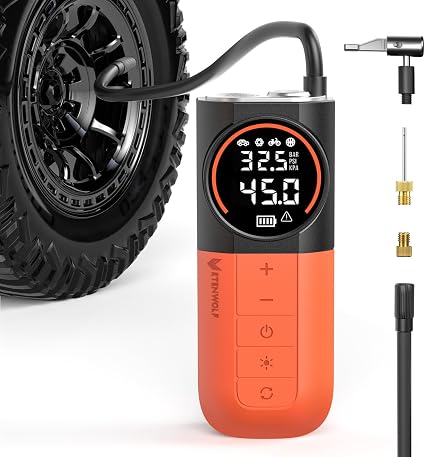
The S1 starts with a different question: how much battery reserve is worth carrying when a route may require more than one correction? ETENWOLF lists a 5,200 mAh battery, a 1.35-pound weight, and a 6.7 x 2.1 x 2.6-inch body. It remains compact, but it is no longer the lightest item in the pouch; the extra mass is paying for a broader operating margin.
ETENWOLF describes up to 60 motorcycle tires from 25 to 30 psi and separately describes a 60-second correction on a 195/65R15 car tire from 30 to 35 psi. Those figures answer different questions. The motorcycle number is an upper-use estimate, while the car number is a defined correction condition. Keeping them separate avoids turning two useful but nonidentical claims into one promise.
The S1's four presets, automatic stop, hose storage, adapters, USB-C charging, and pouch make it a reasonable generalist. A rider who carries the pump for a car, motorcycle, and bicycle can make use of that range. A motorcycle traveler should still identify the one connector that fits the bike and make sure the pump can sit where the hose reaches the valve without the luggage being removed.
Customer reports generally like the reserve and simple controls, while other reports mention heat, noise, and a short-feeling hose. The practical response is to leave cooling space around the pump and avoid packing it under the tent or sleeping bag. The S1's value is reserve that can be reached and used, not a battery figure that stays buried in a specification list.
Choose the S1 for repeated corrections, a mixed-vehicle kit, or a route where the reserve matters more than the last few ounces. The X10 Pro is the more natural compact default. The X9 APEX is the next step when capacity and power-bank function justify another increase in carry weight.
NOCO Air AL5: the low-pressure decision

The AL5 becomes interesting when the tire is nearly empty. NOCO documents automatic shutoff above 3 psi and manual start below 3 psi. That distinction gives the rider a concrete operating rule after a puncture repair or a major pressure loss. It is more useful than assuming a preset pump will behave the same way at zero pressure.
The official specifications put the AL5 at 130 psi, 17 LPM, and 1.8 pounds. They also list a 50-lumen light and USB-C power-bank output. NOCO describes a 20-minute operating window at 50 psi followed by a 40-minute cooldown. This is a controlled roadside tool; it is not a reason to run a hot compressor continuously until a large tire is full.
The product is straightforward to store and operate, and customer reports often praise its build and simple controls. The manufacturer pages do not agree on one precise hose-length figure, so the hose should be judged on the actual motorcycle. The relevant test is whether the chuck reaches the valve around the brake hardware and luggage, not which number appears in a product overview.
Customer reports add short-hose, heat, and gauge-disagreement concerns, and one account notes the absence of a separate 12-volt bypass. Those reports are not a laboratory result, but they point to sensible preparation: carry the independent gauge, give the pump room to cool, and practice the manual low-pressure start before the tire is flat at the roadside.
The AL5 is the strongest fit when very low pressure is the problem you are planning around. Choose the X10 Pro for lighter ordinary carry, the S1 for reserve, or the X9 APEX for capacity and shared power. The AL5's advantage is its defined low-pressure behavior, not its maximum-pressure label.
Fanttik X9 APEX: a larger roadside power system

The X9 APEX is for riders who can make a larger unit earn its place. Fanttik lists a 1.87-pound weight, a 28.86 Wh battery, 27 W output, and compatibility with SUVs, sedans, motorcycles, bikes, and balls. The light and power-bank output make the unit useful beyond one inflation event, but they also move it out of the minimum-bulk category.
Fanttik's comparison gives the X9 APEX a 35-second correction on a 25-inch tire from 30 to 35 psi and a four-tire result from 0 to 35 psi. Those conditions make the speed claims comparable within the manufacturer's table. They do not predict the result on every motorcycle tire or every pressure change, and the rider should plan for heat and pauses.
Customer accounts praise speed, battery life, the light, and power-bank use. Other accounts mention noise, recharge time, and friction from the threaded valve connection. That combination makes the X9 APEX a system decision: the extra weight is reasonable when repeated corrections, night access, or shared power matter, and less reasonable when the pump only needs to top off one tire once.
The X9 APEX is the better tool for remote routes, multiple tires, or a rider who wants one battery platform to do more than inflate. The S1 covers the reserve need in a smaller package, while the X10 Pro is easier to justify in a tight maintenance pocket. The X9 APEX wins on capacity because the rider has a use for it, not because a bigger pump is automatically safer.
ETENWOLF S0: the lightest specialist

At 0.54 pounds, the S0 makes the minimum-bulk case clearly. ETENWOLF describes it as a bike-first 150 psi mini pump with a 2,400 mAh battery, rotating hose, automatic stop, and adapters. It is attractive when the rider already has a broader tire plan and wants a small pressure tool that can travel with a bicycle or occupy almost no motorcycle luggage space.
The product's evidence is bicycle-first. The published example is a 700 x 23C tire moving from 80 to 100 psi in 20 seconds, with additional bicycle-tire claims at lower pressure. ETENWOLF says the pump can inflate motorcycles, but the verified material does not provide a comparable motorcycle fill test. The bicycle result therefore stays in its lane.
That boundary does not make the S0 useless on a motorcycle. The rotating hose can simplify storage and valve approach, and customer reports praise the small shape, charging convenience, and relatively quiet operation. One account reports a Presta-chuck seal problem, which is a reminder to practice the exact valve connection rather than assuming that an adapter list equals a working setup.
The S0 suits a rider who values minimum bulk and accepts the narrowest evidence for motorcycle use. The X10 Pro is the more defensible compact motorcycle default, the S1 provides more reserve, and the AL5 is the better low-pressure choice. The S0 earns its place through weight and fit, not through an inflated performance claim.
Make the pump part of the departure check
Put the inflator where it can be reached with the motorcycle fully loaded. Keep the gauge, charging lead, adapters, and repair supplies in a sequence that can be understood on a shoulder or at camp. Run the complete routine during the motorcycle camping shakedown test: cold target, valve access, hose route, power connection, fill, cooldown, and gauge check.
The pressure target remains the motorcycle's cold specification. The pump's ceiling is not the target, a hot tire is not a normal time to bleed, and a gauge reading is worth keeping independent of the compressor display. If the tire keeps losing air or the damage is outside the repair plan, stop treating inflation as the answer and use the recovery plan.
That leaves a clear choice. The X10 Pro is the compact all-around starting point; the S1 buys reserve; the AL5 plans for low pressure; the X9 APEX consolidates capacity and power; and the S0 minimizes bulk with a bike-first limit. Each can work inside a motorcycle-camping kit when the rest of the tire workflow is practiced before departure.
Reference desk
Sources
- Check Your Motorcycle Tire Pressure
Michelin
- T-CLOCS Pre-Ride Inspection Checklist
Motorcycle Safety Foundation
- NOCO Air AL5
NOCO
- Fanttik X8 APEX vs X9 Pro
Fanttik